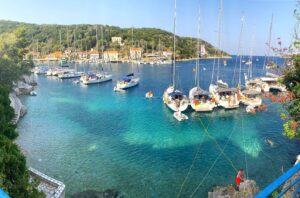

You’ve probably seen photos of sailing or motor yachts anchored in stunning bays, bathed in sunshine and surrounded by crystal-clear waters, and thought how wonderful that must be—the freedom to dive straight in and truly relax. And it is wonderful. I’ve anchored in beautiful bays thousands of times, and that sense of delight has never faded.
So how do you get there? Which cruising area is right for you? How much does it cost? And what should you be aware of before booking?
This article answers all of those questions and more, with particular reference to Greece and the Greek Islands—though much of what follows applies elsewhere too.
How long are yachting vacations, and when can we go?
Globally, most yachts are chartered by the week, with a guaranteed boarding time of 5pm on Saturday. In many cases, you can pay an additional €150–200 for an early check-in, allowing you onboard by 1–2pm. This is often worthwhile, as it gives you the chance to reach a popular port town before sunset and secure a better berth.
Check-out is the following Saturday at 9am, though you must be back in port by 6pm the previous evening. This can feel a little disappointing, as you’re not getting a full seven days on the water. However, there’s a good reason for this. To ensure you receive a yacht that is perfectly clean, well-maintained, and fully reliable, the vessel must be thoroughly inspected on Friday night by the base manager and their team. A diver will also check the keels and propellers for any damage.
Around 65% of charters are skippered by clients who are not professionals and may have limited nautical experience. Minor damage is therefore quite common, though usually repairable. That Friday night to Saturday afternoon window is crucial for maintenance crews to inspect, repair, and prepare the yacht so it is completely ship-shape for your arrival.
In Greece, the sailing season runs from early April to around mid-November—at least seven months of the year. We’ll talk about pricing shortly, but it’s worth noting that a yacht can cost as little as half the summer rate if you travel in the low season.
The exception to these timings is when you charter a fully crewed yacht, typically costing €20,000 ($22,000) or more per week. In these cases, there is far greater flexibility. Charters usually still last a week, but check-in and check-out are often around midday, and the specific days are often negotiable.
Can we stay within our budget?
At the recent New York Travel and Adventure Show, I was struck by how surprised visitors were at how affordable yachting vacations can be. A group of six to eight people can charter a small sailing yacht with a captain for as little as €6,000 ($7,000) per week, plus food.
One of the strongest advantages of booking a yachting vacation in Greece is the enormous choice of yachts available. This allows us to find something that genuinely fits your budget and preferences.
We can source anything from this entry-level option all the way up to a fully crewed superyacht. For every yacht we recommend, we provide photos and videos and clearly explain the pros and cons, so you can make a well-informed decision.
Each yacht also comes with a list of optional extras you can add, such as early check-in, safety nets, stand-up paddleboards (SUPs), Wi-Fi, and extra towels. At the luxury end of the market, these are typically included, along with a wide range of advanced water toys.
Do we need a captain and a hostess, and what do they do?
Most readers will need a captain. However, if you hold an internationally recognised sailing licence, you may skipper the yacht yourself and save some money. We always recommend checking your licence with us first so we can confirm its validity with the Greek Coast Guard.
If you skipper yourself, you’ll be required to pay a security deposit of approximately €2,000–4,000 ($2,200–4,400). If any damage occurs, the cost is deducted from this amount.
A captain’s role really deserves a blog post of its own—and I’ll be writing one shortly. In summary, the captain is responsible for navigating and safely manoeuvring the yacht along a route that you agree on together. In practice, the captain also becomes your informal travel guide. Even if you’ve researched destinations, you may not know what’s involved in reaching them, what the weather conditions might be, or what to expect locally.
While captains are not officially there to plan your holiday, a good one absolutely will. They’ll understand your preferred pace, read the group dynamic, and suggest destinations that come together to create a truly beautiful experience.
A great captain will make your holiday unforgettable. A poor one can make it stressful. We only recommend captains we know well, so please do ask if you need one.
A hostess ensures that all food, drinks, and supplies are onboard when you arrive—which is far easier than doing the shopping yourself. They usually cook two meals per day, wash up afterward, serve snacks and drinks, and remove waste from cabins. However, they do not clean up your cabin usually. There is room for negotiation, but before the vacation starts so all expectations are established.
What Are the Costs Involved?
On a standard charter, there are five main costs:
-
Yacht hire – the largest expense
-
Captain – typically €1,400–1,600 ($1,600–1,900)
-
Cleaning, linen, and consumables (gas, toilet paper, etc.) – around €350 ($400)
-
Fuel – on a monohull without air conditioning, as little as €150 ($170) per week; on a catamaran with extensive A/C use, up to €600 ($800)
-
Returnable security deposit – usually €2,000–3,500 ($2,200–4,000), paid by credit card (sometimes cash). This deposit works much like a car rental deposit. If you have a skipper, they are responsible for any damage they cause. Security deposit waiver insurance can often be purchased for typically €400–600 ($500–800) which drastically decreases the returnable amount you would pay.
Additional costs include mooring, water, and electricity fees at ports, which are usually modest—around €15. Some marinas can be booked in advance and may cost closer to €70 per night, plus utilities. These are limited in number and can be discussed with your captain.
You will also cover your captain and crew’s meals. You may choose to eat together or separately—both options are perfectly fine, and crew members sometimes appreciate a little downtime.
On luxury charters, costs are structured differently. One main fee covers the yacht and crew, and you then pay an additional 20–30% as an Advanced Provisioning Allowance (APA). This allows the crew to purchase fuel, food, and supplies on your behalf. Any unused funds are returned to you at the end of the trip.
Which region is best for us?
Every region of Greece offers something unique, while sharing common pleasures such as warm hospitality, charming port towns, clear waters, and the freedom to explore by boat.
For first-time sailors, the Ionian Sea or the Sporades Islands are excellent choices. The weather here is typically milder, with more shelter and shorter distances between islands. The Ionian lies on the west coast, while the Sporades are on the east, halfway up the mainland.
If you’ve sailed before and found your sea legs, the Dodecanese offers a more rugged and dramatic experience, rich in history, myth, and powerful natural beauty.
If you dream of whitewashed towns perched above the sea, the Cyclades are unmatched. However, this region is known for the Meltemi winds, which can be strong. An experienced captain will guide you safely through them and know when it’s best to remain in port.
Other options include the North Aegean (around Halkidiki, Limnos, and Samothraki) and the Argosaronic Gulf (Hydra, Spetses, and Poros), both of which offer milder conditions.
In short, start with the Ionian or Sporades for your first trip—but let’s talk it through. These blogs are designed to give you depth and clarity, after which we can fine-tune everything personally.
How does payment work—and what if we change our minds?
To secure a booking, you’ll need to pay 30–50% of the yacht rental fee within a week of deciding you want a certain yacht. Once payment clears, the yacht is confirmed for you. Until then, it is held temporarily—no one else will book it while you’re in the process.
The remaining balance of the yacht hire is due at least 35 days before departure. Other fees are typically paid on the day of the charter, usually in cash, except for the security deposit, which is paid by credit card.
Cancellation policies generally work as follows:
-
More than 100 days before departure: 25% of the charter fee is retained
-
35–100 days before departure: 50% is retained
-
35 days or less: 100% is retained
In some cases, owners may allow you to defer the charter to the following year, though they are not obliged to do so. So you should be sure enough before booking a yachting vacation that you really want to go because if you cancel you will most likely lose 25% of the yacht hire fee.
What is a typical week like?
On a typical day, you’ll sail or motor for two to three hours, enjoy one or two swim stops, and spend the night either in port or anchored in a quiet bay. Port space is limited and cannot be pre-booked, so arriving early helps. If no berth is available, anchoring in the harbour and using the tender to go ashore is often a fun—and more private—alternative.
One of the greatest joys of a yachting holiday is that you control the pace. You can move frequently and explore widely, or slow things down and linger in bays and towns. It’s entirely up to you.
How safe is it?
This is a topic I’ll explore in detail in a future blog, complete with real stories and scenarios. In short, yachting is very safe and reliable.
While wind and waves can be powerful, yachts are designed to handle them exceptionally well. Most risks involve discomfort rather than danger. Weather forecasting is highly reliable, allowing plenty of time to plan and adjust routes.
The main hazards—shallow waters and collision—are entirely manageable with proper charts, depth sounders, and skilled captains. Giving others a wide berth is key, especially when you can’t rely on their level of experience.
Where do we fly to—and should we arrive early?
The main airports for yachting vacations in Greece are Athens, Preveza/Aktion, Corfu, Rhodes, Kos, Volos, Skiathos, and Thessaloniki. All are well connected during the summer, with excellent international links to Athens.
If you’re flying from a significantly different time zone, consider arriving one or two days early. Spending time in a place like Athens allows you to recover from jet lag and explore areas you won’t easily reach by sea. We’re always happy to make recommendations.
Final words
Well done for making it to the end! I’ve tried to keep this as concise as possible while still giving you a clear and realistic picture of what to expect.
When you contact us, we’ll happily answer every question you ask—and often a few you haven’t thought of yet but really should know.